Thursday, June 30, 2011

Balloon Launch and Sheep

This week, the Rocket Range is hosting the European Space Camp, where a group of high school students from all across Europe come here to learn about the rocketry and other science activities that go on here, and to put together and launch a rocket of their own, similar to the kind that the local school launched a couple weeks ago. On Tuesday, one group of these students put together and launched a radiosonde (a box of scientific instruments which is attached to a helium balloon and communicates the data to the ground by radio), and since this is also relevant to my research, I got to sit in on the lesson and watch the launch. Here are some pictures from it:

Balloon peeking up from inside the tower, about to be released

Balloon going up; scientific instruments hanging by a string
One interesting exchange that occured during this lesson was when the students were having a discussion on international affairs and the US-China relationship in particular. Someone asked me, "You're from the US, right? Do you hate communism?" I said "yes", not thinking too much and causing much laughter. To be honest, I'm not a free-market capitalist ideologue either, but I believe that communism inevitably leads to authoritarian regimes with serious human rights abuses, so I stand by my answer.

Since it was cloudy, there were no lidar observations at the time of this balloon launch, which left open the possibility of me launching a balloon myself, with funding (these things are expensive) provided by Trude, my Yale advisor. But now I realize that they launched balloons before the rocket launch that I blogged about a couple weeks ago, and since that was a clear day, there were lidar measurements too. So there's probably no need for me to launch my own balloon.

Another interesting thing that's happened recently is the flock of sheep that's been hanging out by the lidar observatory (see pictures below). They've been there every day this week, sometimes even getting in the way of cars on the road. They have bells hung around their necks, so they're obviously owned by somebody. I asked how the owners find them for shearing if they can just  wander anywhere--it turns out that every autumn, there's a big sheep roundup where they enlist a bunch of volunteers to drive around the island searching for sheep. The island is pretty big (35 miles long and 8 miles wide) but they must, after all, be somewhere on the island, unless they manage to walk across the bridge at Risoyhamn (see the "Excursion Part I post") to the next island, or get eaten by foxes (see last post). And there's not too many trees on the island, which makes the sheep easy to see, while the bells make them easy to hear. 


Sheep, from outside my office window (my office has moved since the fox pictures)

There were a couple black sheep mixed in. They seem to like drinking from puddles.

I don't know what the big concrete cylinder is, but I know it's not for feeding sheep. The sheep failed to realize this.

The Rocket Range's bikes have finally gotten out of the repair shop, so I can finally go to the grocery store and downtown Andenes without walking for several miles. They came in just in time, because I need a way to get downtown to pick up the Whale Safari boat on Sunday (which I'll definitely post about). Also, there's another rocket launch tomorrow, for the European Space Camp, which should be fun to watch if the weather is good. (If it's cloudy, the rocket will disappear into the clouds almost immediately.)

Friday, June 24, 2011

Rockets, Foxes, and Balloons

I am staying at the Andøya Rocket Range (of which the Lidar observatory, where I'm doing my work, is a subsidiary), and they do, on occasion, launch rockets. The main focus is on launching "sounding rockets", which don't enter orbit but do often reach space. The purpose of these is to measure various atmospheric conditions, such as temperature, pressure, wind speed, and the ionization of the air, at a higher altitude than can be reached by weather balloons. The biggest rockets are launched in the winter, where they use them to study the Aurora Borealis and other wintertime upper-atmospheric phenomena; due to its location, Andenes is well suited to launching rockets that follow the earth's magnetic field lines, and other interesting flight paths.

In the summer, the rocket range focuses more on educational outreach. The first rocket launch that occurred during my time here was for the Andøya Ungdomsskole ("Teen School")--the students at the local school, who seemed around late middle school/early high school age, were responsible for building a small sounding rocket, and overseeing the countdown to the launch last Thursday. I was able to watch the countdown and launch from the User Science Operations Center (a legitimate "mission control"-type room), and it was interesting to see how the process worked.

This wasn't a water bottle rocket, or a model rocket with an A, etc. engine, like what I did in middle and high school--it was a legit multi-stage rocket, that actually reached an altitude of about 25,000 feet. I'm not sure exactly how big their role was or how well they understood the science involved, but it speaks well for the Norwegian educational system that the students at a small town public school have the opportunity to do this. Obviously, not all schools have a rocket range two miles away, but I imagine that such partnerships between public schools and scientific research facilities are common.

I was just a split second too late to actually catch the rocket in my picture, but here's the plume from the launch. The next launch will be on Friday, and will be for the European Space Camp, which will be staying in the rocket range's hotel next week (this should be interesting).


I won't be launching any rockets myself, but I may get to be involved in launching a radiosonde, more commonly known as a weather balloon, which serves basically the same purpose as a sounding rocket but is much cheaper, and intended for the troposphere, or lower atmosphere (which is what I'm interested in, since that's where all the weather happens). What I've been working on for the past few weeks involves using temperature and pressure data from a weather balloon to calculate a theoretical lidar profile, based on the assumption that assuming the air is clean and has no aerosols, and then comparing it to the actual lidar profile to obtain a profile of the aerosol concentration. But the data I've been using are from balloons launched in Bodø, almost 150 miles away, so I'd like to look at some data from Andenes to see how good an approximation the Bodø soundings are. They don't launch balloons from Andenes very often, but they'll be doing one next Tuesday, and I might also be able to launch another one, paid for using Trude's research funding, next time there's good weather so that the balloon will be simultaneous with the lidar measurements. 

The lidar observatory, being on top of a mountian in a sparsely populated area, is visited by wildlife occasionally. Recently a wild fox walked up right outside the window, leading everyone to interrupt their work and look at it; pictures below. Today I saw three white animals that I thought were sheep or goats, but I didn't get a chance to investigate further.


I had to switch rooms on Wednesday because they needed to clean the old room, and apparently I had to vacate the room for them to do that. The new room is on the second floor and on the opposite side of the building--now, instead of facing the ocean, I'm staring right at the side of the mountain (see pictures below). But the construction was taking away the old view anyway, and now it's easier to make the room darker during the midnight sun so that I can sleep more easily.


This will probably be a pretty uneventful weekend, because I don't have any mobility--the Rocket Range inexplicably took the bike I was using away for repairs 2 weeks ago, with no word on when it will be returned. But next weekend, I intend to do a really sterotypical tourist activity: whale watching. The cruises leave from Andenes and people go out of their way to come to Andenes to get on the boat, so it wouldn't make sense for me to stay here for so long and not do it. There's a 90% chance of seeing whales--they actually use electronic detectors to find them--and they give you a free trip if you don't. If I don't have a bike by then I'll just walk several miles to downtown.

Tuesday, June 14, 2011

Excursion, Part II: Bodø

(continued from Part I)

I woke up on Sunday, June 12 in the Bodø hostel. The term "youth hostel" doesn't really seem to apply--there were people there from all ages and backgrounds, from young travelers like myself, to families, to middle-aged tourists and old men. The Norwegian word for "hostel" is "vanderhjem", which I think literally means "wander home"; I think this is a much better term than "youth hostel".

Norwegian Aviation Museum
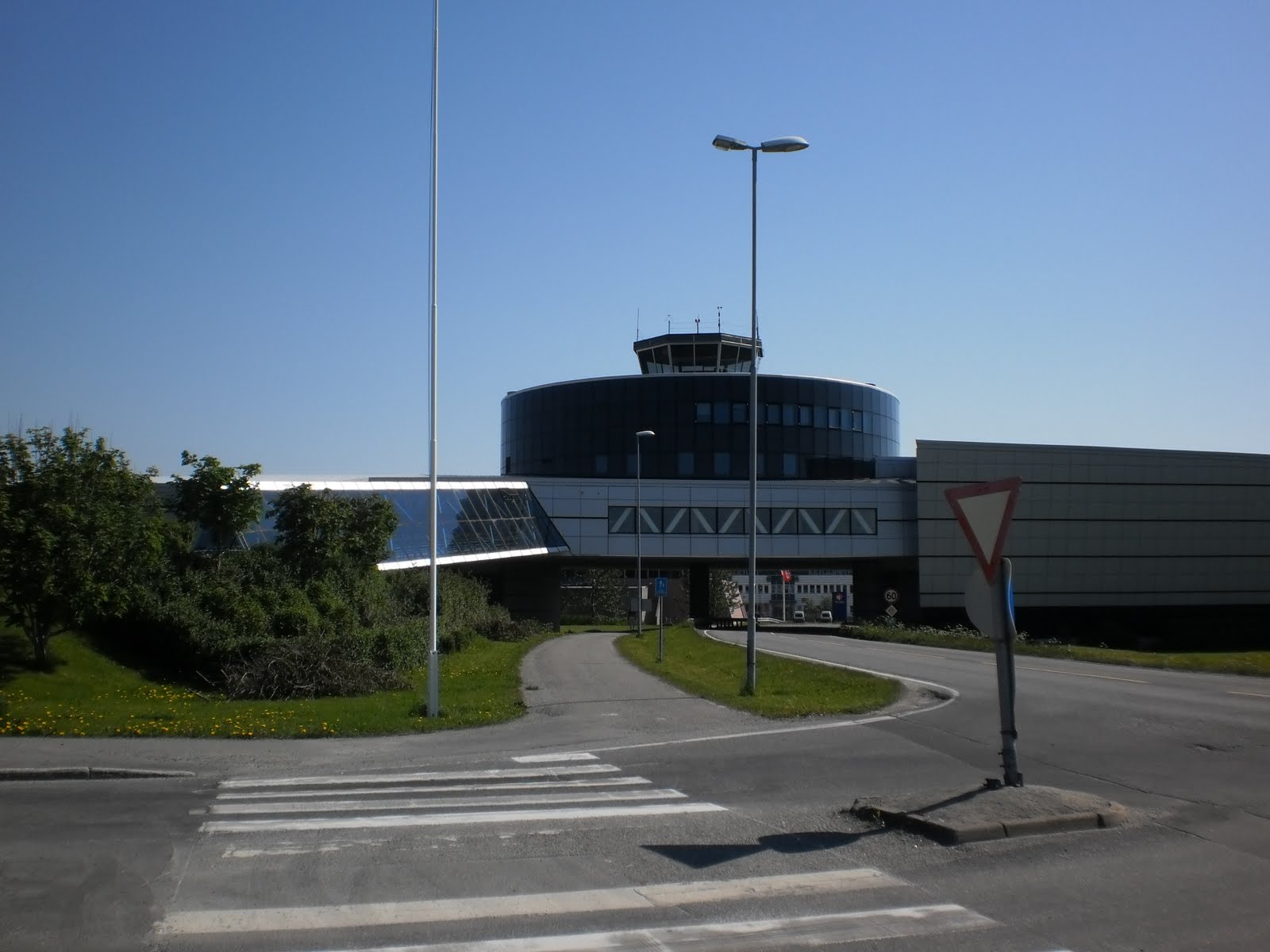
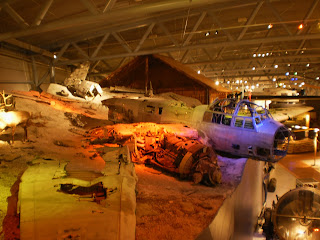
I took advantage of the hostel's free breakfast (a surprise considering this is Norway), grabbed a map of the city and checked out. After storing some luggage in a locker at the train station below the hostel, I walked to the city center; finding everything either not open yet or closed for the day, I made my way to the Norwegian Aviation Museum, which is listed first on every list of things to do in Bodø, but was a good mile and a half walk from the city center. The museum was pretty interesting. From the outside, it seemed to be designed to remember a propeller, seen from above; inside, there were lots of military and civil aircraft hanging from the ceiling, as well as peripherals like missiles, anti-aircraft guns, and radar installations. The best part of it, to me, was the detailed history of the military use of aviation, from the first use of balloons in reconnaissance to modern spy planes, complete with actual examples of each type of plane. The civil side wasn't as interesting--more just bragging about Norway's extensive airline system, and histories of its major airlines, in which I suspect the airlines may have had some influence--but still, it was interesting to see the cutlery used by airlines back when they actually served meals.
WWII airplane wreckage

Ejector seats
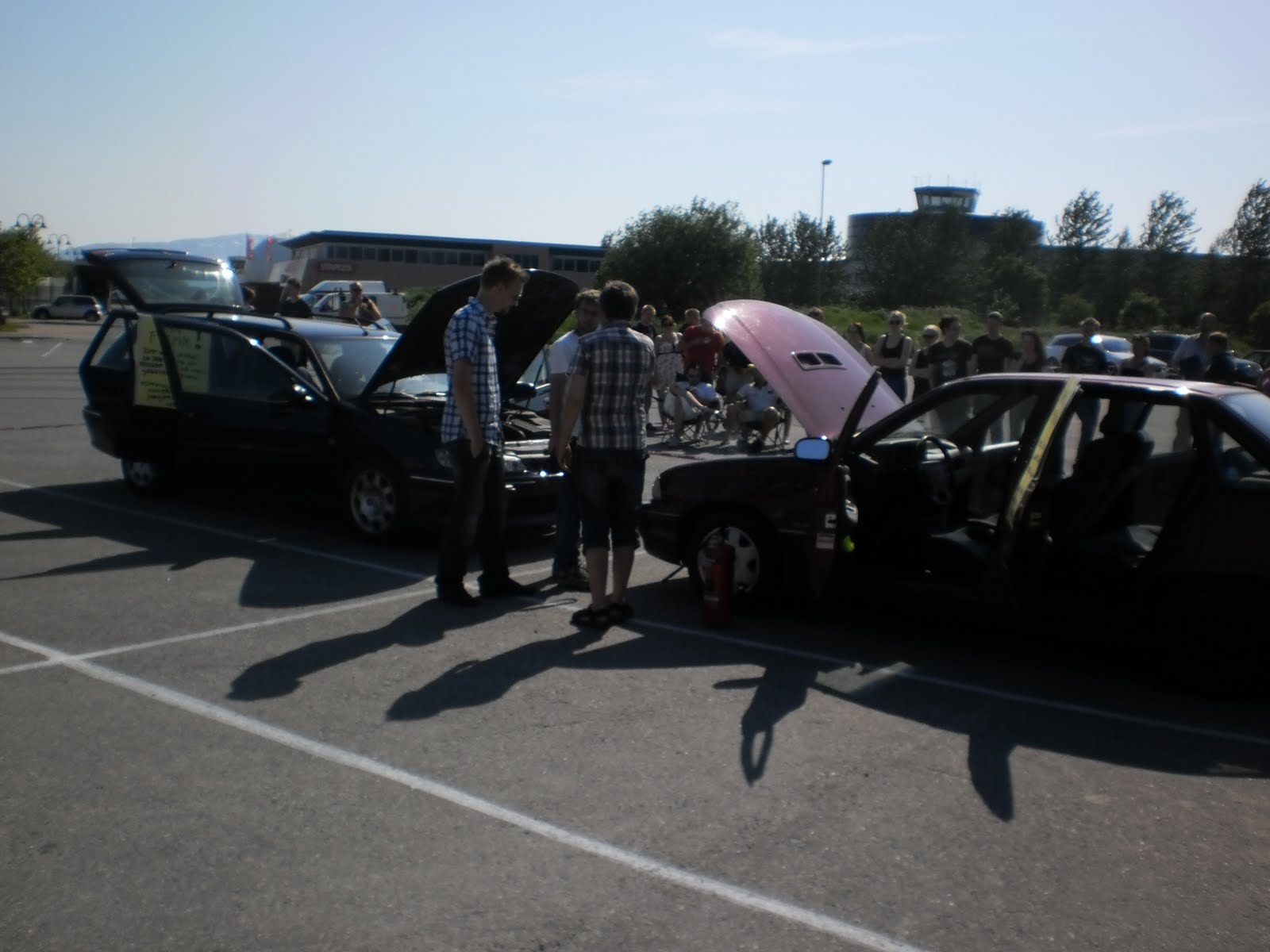
While walking back toward the city center, I noticed an event going on in a parking lot. I wasn't too curious about it, until I realized that the concession stand had an American flag painted on it, and that the cars in the parking lot were all American cars. It turned out that this was a meeting of the local chapter of the American Car Club of Norway, an organization dedicated to American cars, both classic and modern. (An excerpt from their website: "[Our] main goal is to make sure that American cars as a hobby is allowed to prosper in Norway. Therefore we are deeply involved in politics concerning the import of such cars to our country.") The main purpose of the gathering seemed to be to hold a competition to see who had the best cars (some were truly impressive classics); there was also an event in which two cars' engines were blown out. I've always thought that Europeans like to ridicule the U.S. for our excessive dependence on and obsession with cars, so I was quite surprised to see so many Norwegians apparently obsessed with this aspect of American culture, especially considering the price of gasoline here is about double that in America. When I told the concession stand operator I was from the U.S., he said "nice"--the first time I've gotten that reaction.

"Engine Explosion Competition"
This man's prize: a model car.

By the time I made it back to the city center, almost everything was closed (this being Sunday, not much was open in the first place), except for restaurants and a newsstand, where I bought an English copy of Time Magazine for $8--now I finally have some reading material. It was pretty hot outside, but even hotter inside--this being the Arctic, no one seems to think air conditioning is necessary--so I just stayed outside, as it seemed everyone else was doing. I went down to the end of the pier and sat down to read the magazine, since I had some time to kill. One advantage of this latitude is that I could do that without having to worry about getting a really bad sunburn, like what happened to me in Martinique.

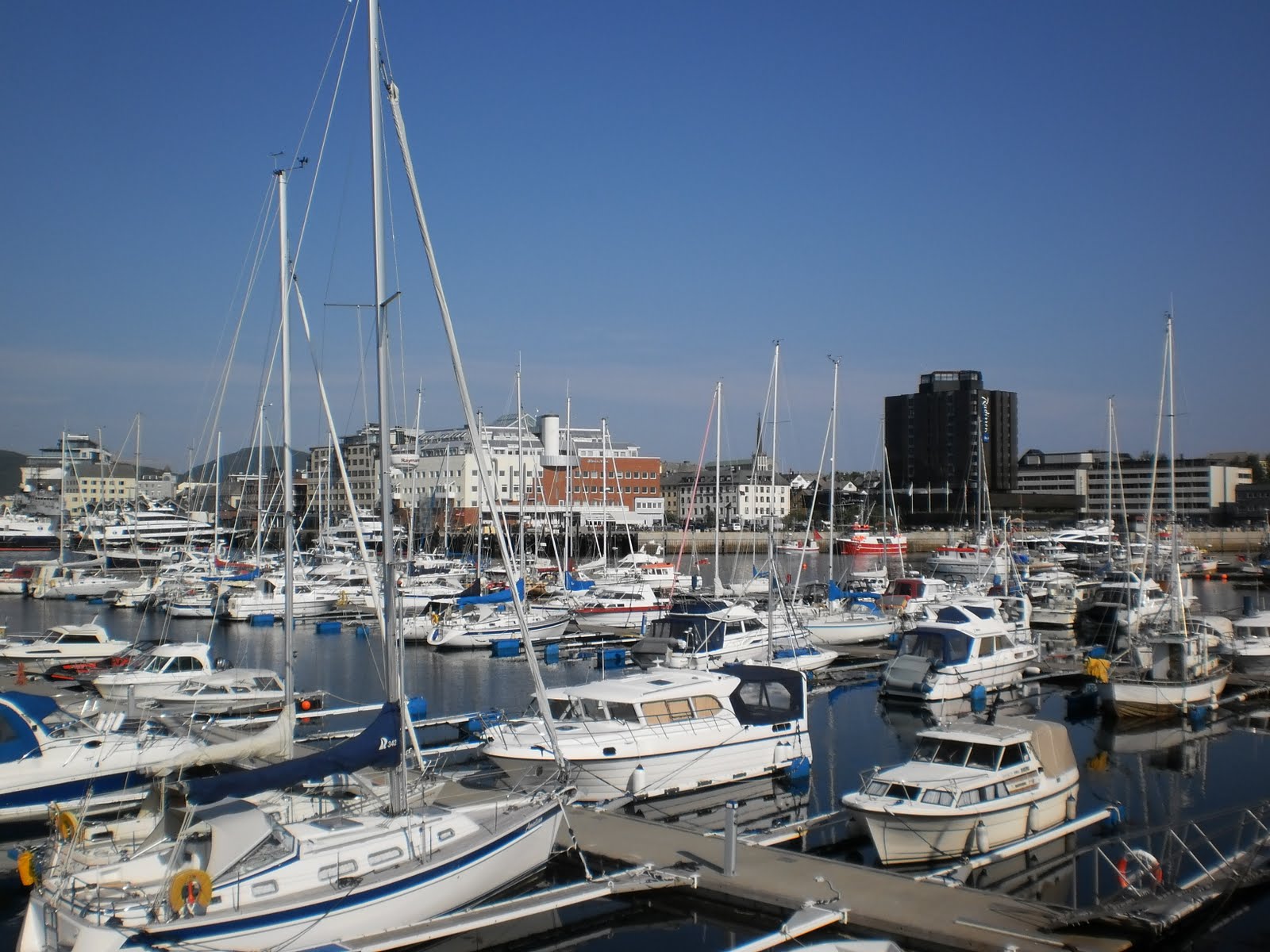
Bodø from the harbor
I then had an $18 dinner at Burger King (I guess that's what happens when the minimum wage is over $20/hr) and went back to the train station to pick up my stuff, then back to the city center where the bus terminal was. I was hoping to take a city bus to the airport to pick up my flight back to Andenes, and the schedule posted at the bus shelter clearly said that there were supposed to be buses to the airport every hour at 50 past the hour on Sundays, from 5:50 PM onward. I got there at 6:40 to take the 6:50 bus, but as of 7:20 there was still no sign of a bus, or of any buses from other routes either, including one that was supposed to stop at the same shelter at 7:10. I realized that I hadn't seen a single city bus during my entire time in Bodø, and other people also seemed be waiting for buses and giving up after a while. Eventually, I concluded that none of the buses were running that day, and not wanting to pay for a taxi at Norwegian prices, I just walked the 1.2 miles to the airport (I had plenty of time since my flight wasn't till 10:05). On the way I saw people with bags walking the opposite direction.

I still can't figure out why the buses weren't running. Even though it was Sunday, there was supposed to be scheduled service. It was also the middle day of a 3-day weekend, and hence a light travel day (which is why I was able to get a cheap flight), but there were exceptions to the schedule posted on the bus shelter and June 12 wasn't one of them. But since Bodø is in the same county (Nordland) as Andenes, it might be that the city buses are run by the same company as the long-distance bus I took from Andenes to Risøyhamn. When I tried to look at the website for that, it said that there was a "route search error" for June 12, and to call the company (which I didn't have much success with on the occasions that I tried). My first guess was that the company realized it would be a light travel day and decided to cut back on or cancel all the bus service to avoid losing money--even if they're getting government subsidies, they wouldn't want to run empty buses--and it wasn't in their interest to make it plainly obvious to people that the buses weren't running. When I mentioned this to someone back at Alomar, she speculated that the bus workers may have been on strike. Either way, it doesn't speak well for the idea of privatizing public transportation, especially if you give one private company a monopoly. (A political aside: I'm pretty skeptical of congressional Republicans' plan to take away Amtrak's Northeast Corridor, its only profitable route, and give it to a private company--this would lead to problems when riders' interests wouldn't line up with the company's, and the rest of Amtrak would be even more subsidy-dependent, possibly leading to its elimination.)

Having literally walked about 10 miles in Bodø, I was really exhausted when I got back to Andenes, and I spent the last day of the weekend basically recuperating. But now I'm getting back into work. After this week, Zuguang's going to China for 3 weeks (both for business and to visit family), so I'm trying to finish as much as I can this week to take advantage of his expertise while he's here. Right now I'm working on an algorithm to determine aerosol concentration by subtracting the real lidar profile from a theoretical one, calculated from the temperature and pressure readings from a weather balloon. If I can finish this really technical part by Friday, to Zuguang's liking, then the rest of my analysis will be much more about the atmospheric science than about the physics of the instrument, which is Zuguang's specialty, so it shouldn't be too much of a problem that he's not here. But I might be more tempted to sleep late, and work from home rather than going to the lidar observatory at 8 AM.

I'm now just past the halfway point of my time in Norway. I probably won't go on another excursion like this one, because it was expensive, and logistically difficult, and other cities in the region would be even more so. But I'll try to do some touristy stuff in Andenes, such as climbing the lighthouse, visiting a couple museums and maybe going on a whale-watching or fishing cruise (if the waves are small enough that I wouldn't get sick), the next time there's a weekend with good weather.

Monday, June 13, 2011

Excursion, Part I: Hurtigruten Cruise

I've returned from an exhausting and expensive, but really interesting and in some places spectacular, excursion to Bodø, a medium-sized city about 150 miles south of Andenes, but still north of the Arctic Circle. I took the Hurtigruten ("Coastal Express") boat on the way down, and flew back.

To get on the Hurtigruten on Saturday, I had to go to Risøyhamn, a village on the same island as Andøya but about 25 miles south. There's a bus that goes between there and Andenes, run by Nordland 177, a company which is responsible for all the bus service in Nordland County (a Norwegian county is the equivalent of a U.S. state). The bus left Andenes at 7:20 AM so I had to get up pretty early.The Rocket Range's bikes were (and still are) in the shop for repairs, so I had to take a taxi to get to downtown Andenes. Since I also wanted to withdraw from an ATM downtown, and I wanted to be conservative with the time, I ordered the taxi for 6:50. But when I waited outside there was no taxi, and at 6:58 I called the company again. They said they'd be there in 10 minutes. At 7:10, and still no taxi, I was getting really nervous--if I missed the bus, I'd have no way to get to the boat, unless I used the apparently unreliable taxi company. So I started walking toward downtown, even though it's far more than a 10-minute walk, hoping I'd meet the taxi on the way and save time, or maybe intercept the bus itself. Finally I made it to what looked like a bus shelter and realized that the bus probably stopped there, which was confirmed when someone else came out to wait for the bus. (By the time the bus arrived there was still no sign of a taxi--I won't use them again.)
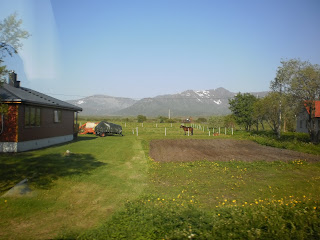
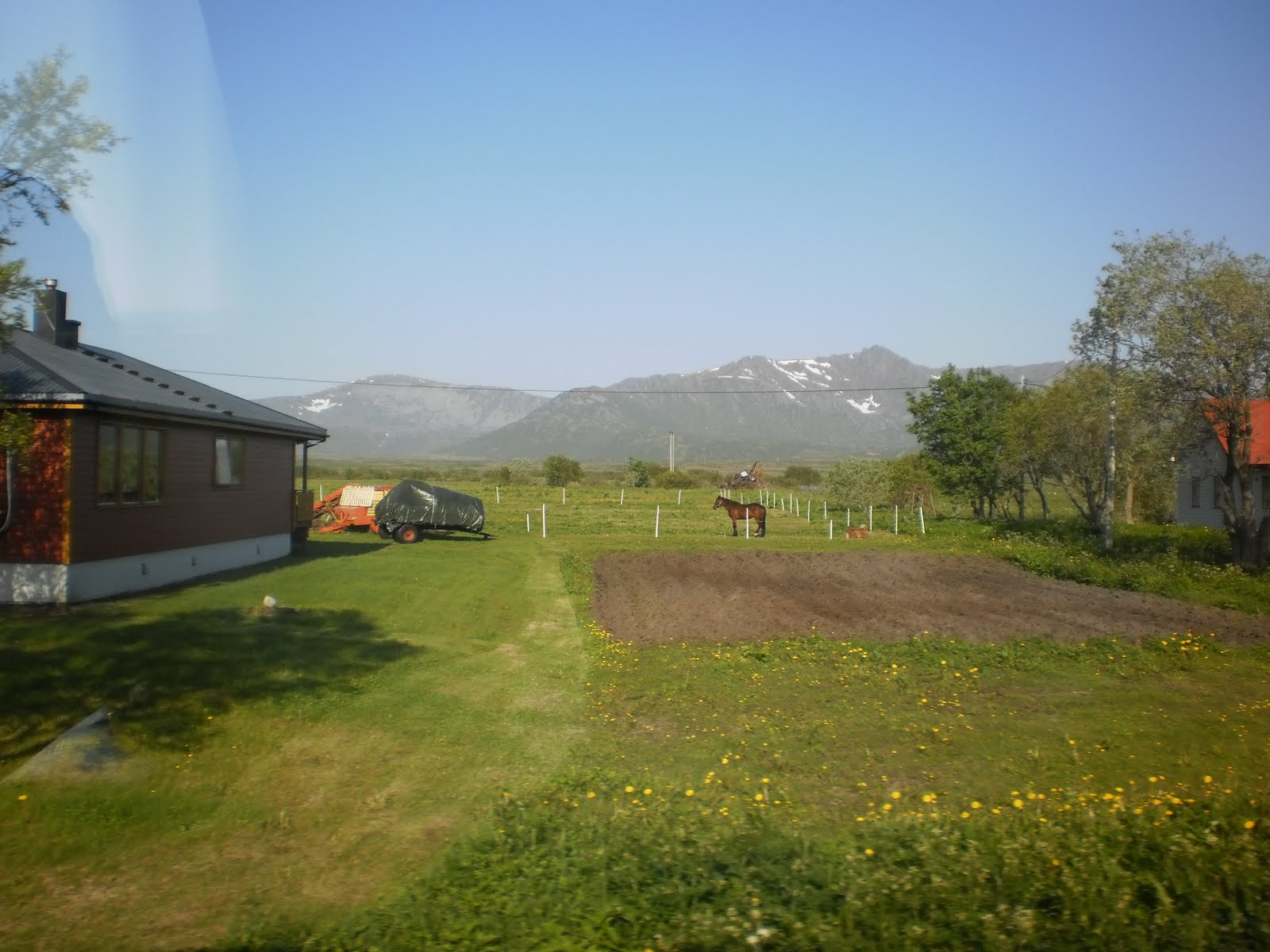
Scene on Andøya island, from the bus
The weather was really nice, sunny, if a bit hazy--much better than the previous long weekend. Even the bus ride was scenic. Andøya is sparsely populated but most of the people seemed to live along this one road. The bus arrived in Risøyhamn right on time, at 8:20, leaving me with 2 hours and 25 minutes before the Hurtigruten was set to arrive.
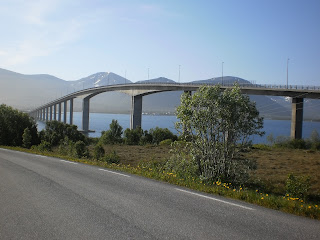


Risøyhamn Bridge

The only structure of note in Risøyhamn was the bridge connecting Andøya to the rest of norway, and there wasn't to much to do there. I basically just walked around looking for a place to eat, and it turned out the only option was a convenience store that opened at 9:30.


Hurtigruten at Risøyhamn

The  Hurtigruten is probably best described as a small cruise ship, since it seemed the vast majority of passengers had rooms and meal plans and were there for the entire 12-day cruise from Bergen, in southern Norway, to Kirkenes, near the border with Russia, and back. But it also transfers freight, and functions as a ferry for people like me, going on short trips from one port to another. In any case, it was a pretty nice ship, with an observation lounge and plenty of deck space for viewing the scenery. Since it was built in the early 80s, and the second oldest of the Hurtigruten company's boats, the interior could've been a lot nicer. But most importantly, the boat was big enough, and the water calm enough, that I didn't get seasick, which would've ruined the whole thing.

Before reaching Bodø, the ship stopped at 4 towns in the Vesterålen and Lofoten Islands, all of them beginning with S: Sortland, Stokmarknes, Svolvær, and Stamsund. Sortland and Stamsund were only 30-minute stops so I didn't want to get off the boat, but from their appearances it didn't seem worth it anyway. Stokmarknes contained the Hurtigruten Museum (admission free with a ship ticket), which, predictably, involved the company glorifying itself and wasn't too interesting. They did have an older boat from their fleet, built in the 30s, which we could explore. But it wasn't too different from the ship I was on, the lounges, etc. having been renovated in the 70s, except that the cabins were really small and cramped, reminding me more of the 19th century whaling ship at Mystic Seaport in Connecticut than of my own memories of Carnival and Disney cruises.
Hurtigruten Museum, Stokmarknes
Svolvær
Svolvær was the most interesting of thes ports, with interesting modern architecture, a spectacular setting, and huge racks where they dry fish. The boat stopped for 90 minutes there, which was enough time to get some dinner, not wanting to eat on the boat. Most of the delis and bakeries were closed for dinner, and I didn't want to eat at a sit-down restaurant for fear that I wouldn't make it out in time, but I found a place that sold Doner Kebabs, apparently a very popular fast-food-type preparation in Europe. It tasted very good, at least on par with American fast food.


Fish being dried at Svolvær
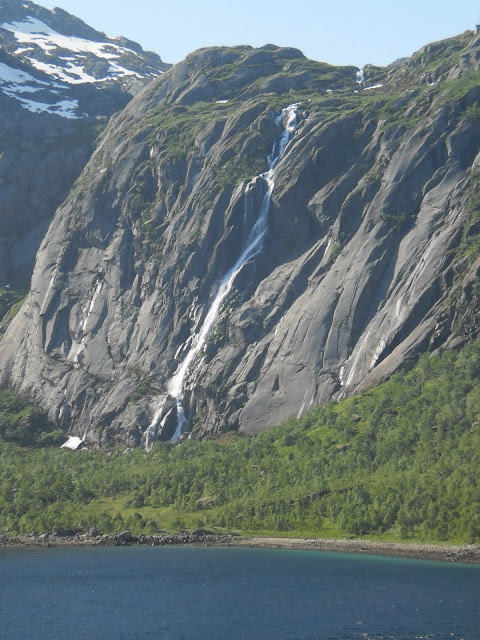
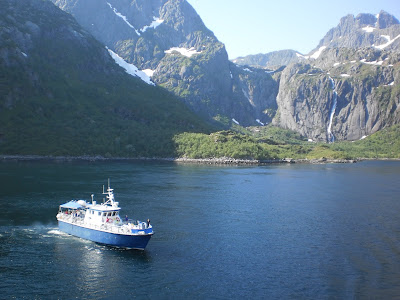
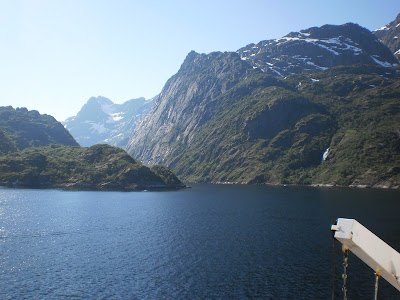
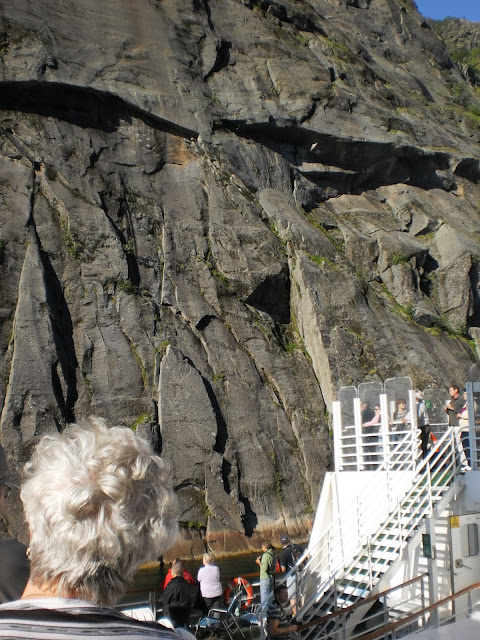
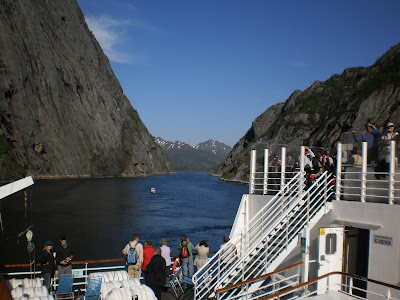
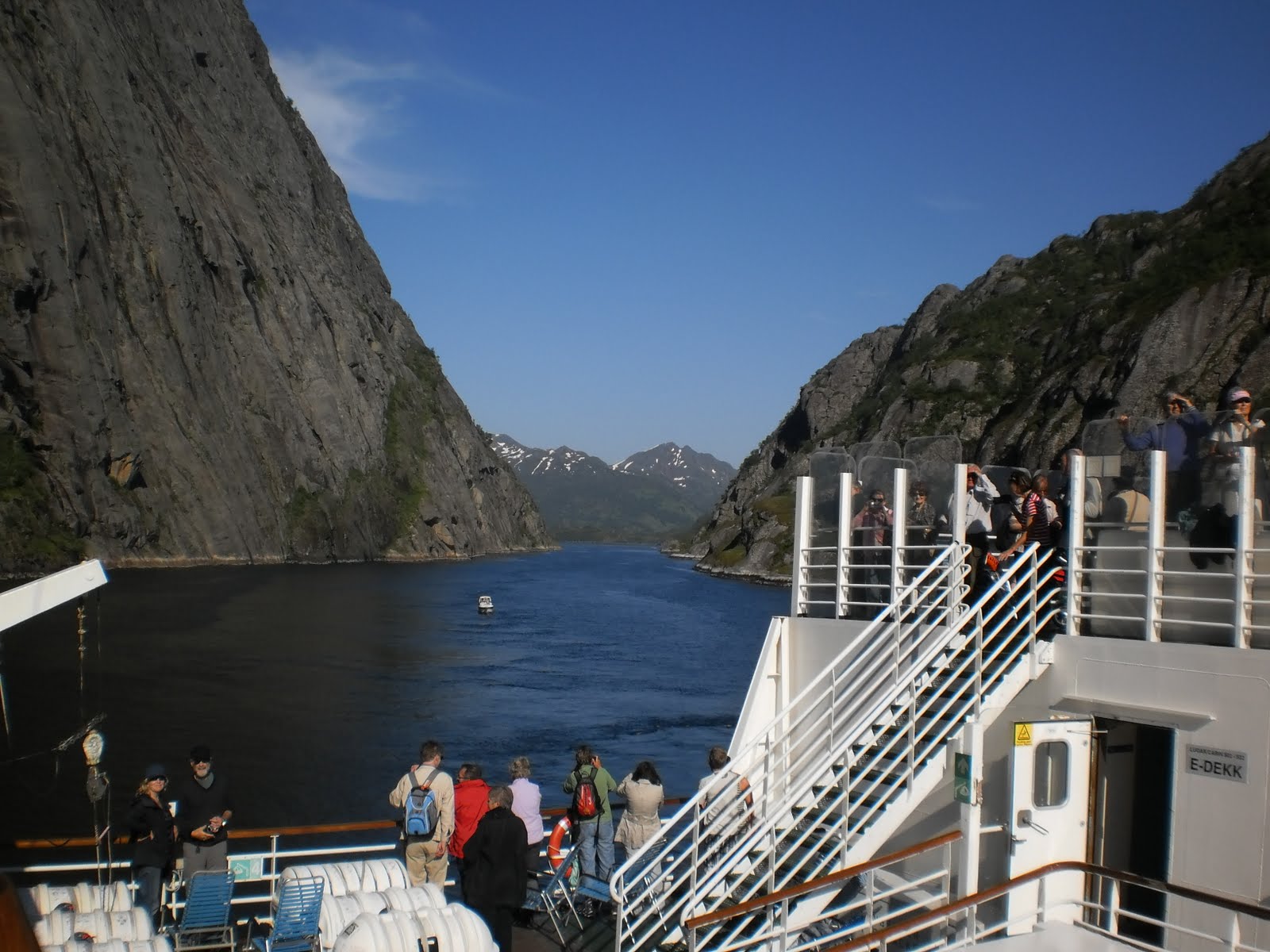
 Really, though, the most interesting part of the trip wasn't the ports, where the short stop time prevented me from really seeing much, but the scenery between the ports. Between Stokmarknes and Svolvær were some of the most famous parts of the entire cruise, including the Raftsund, a narrow passage between two islands with lots of waterfalls, and the Trollfjord, a narrow arm of ocean, barely wider than the boat, which is surrounded by near-vertical cliff faces that reach up thousands of feet. At this point, there were so many people out on the deck that it was hard to get a spot near the railing. I've appended photos from this stretch at the end, and I'll put more on the Flickr account when I get a chance.

After Stamsund was a 4-hour stretch of open water between the lofoten and the mainland. There was no interesting scenery to look at, so there were some Norwegian fairy tales told by an "award-winning storyteller". She seemed pretty talented, interspersing the tales with some traditional instruments, but since 2 of the 3 stories ended with "they lived happily ever after" I somewhat doubt their authenticity. In any case, they didn't have morals or life relevance, like Aesop's fables or Greek mythology, and just involved some trolls, and the good guy winning through arbitrary plot contrivances, so I struggle even to remember what they were about. After this was over, I slept for a little in the lounge, waking up at 2 AM when the ship arrived in Bodø. This was the end of the boat journey, and I made my way to the train station, the location of the hostel where I was staying. The hostel was a clean, modern facility, but it was pretty cramped--there were 4 guys in room smaller than my room at the Rocket Range, with 2 pairs of bunkbeds, and with no A/C (it was surprisingly hot weather) it wasn't too comfortable. But I was really exhausted so I slept well anyway.

It's getting pretty late and I need to get up for work tomorrow, and this is taking quite a while to write. I'll finish this with Part II, about the day I spent in Bodø, tomorrow. In the meantime, here's some fjord pictures, as promised. (Click on any picture to enlarge it.)


Entering the Raftsund

Norwegian civil engineering

 
Big waterfall in Raftsund


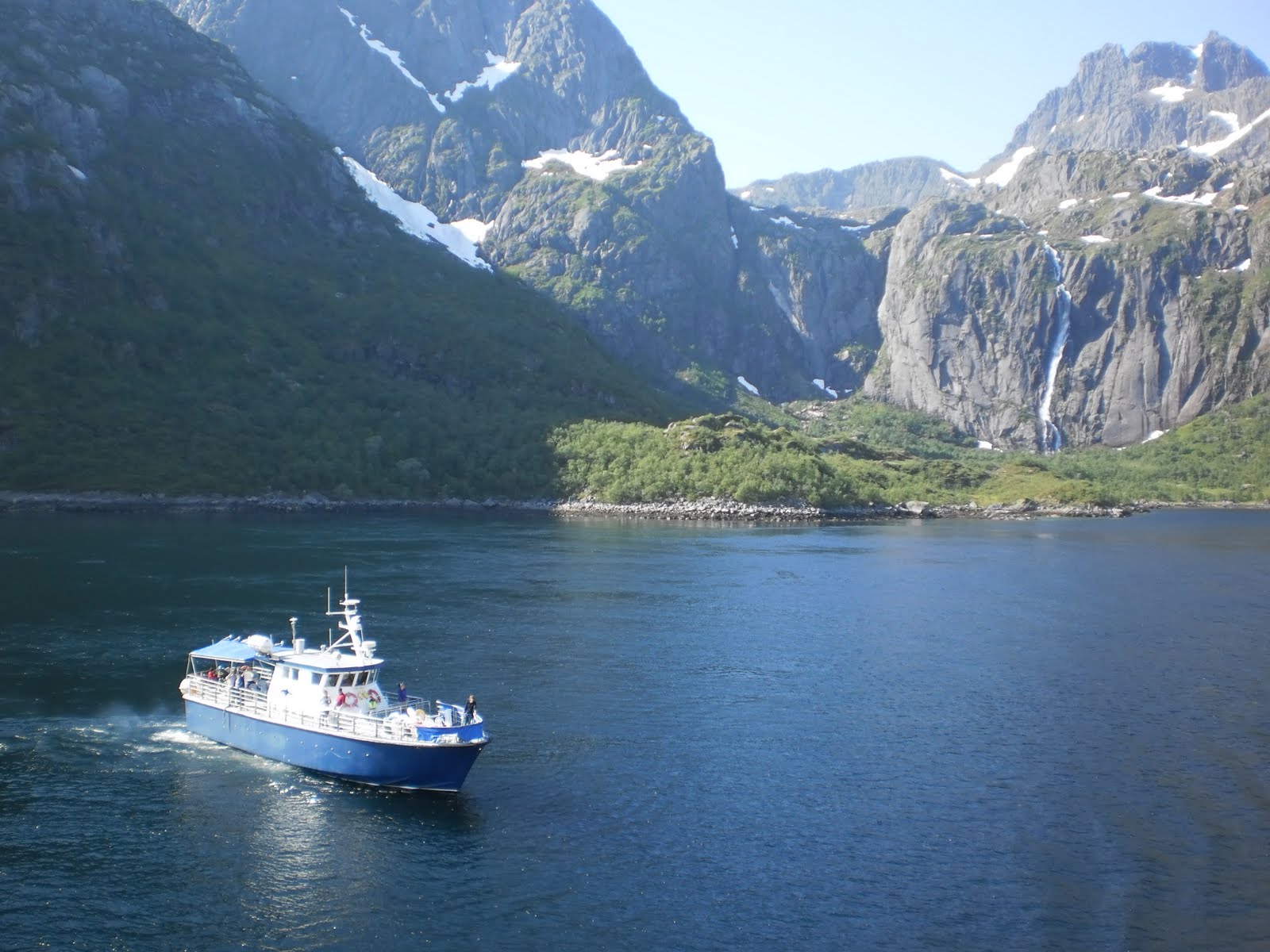
An excursion boat (for Hurtigruten customers who temporarily leave to do other things)
 
Entering the Trollfjord
 
Staring at rocks


End of the Trollfjord; about to turn around

Looking back towards entrance

Waterfall in Trollfjord

Another waterfall in Trollfjord, back near the entrance


Monday, June 6, 2011

3 weeks down

It's been a while--time for an update. Zuguang's been back for the past week, and my plans are starting to take shape. It turns out I can't really obtain many of the optical parameters from the lidar, such as extinction and backscatter coefficients and depolarization ratio, due to various reasons involving licensing restrictions and intellectual property concerns for the software used to calculate them. So this means I can't really identify the ash plume from the recent Icelandic volcanic eruption, which I was hoping to do. But thankfully, Zuguang's explained a relatively simple way to get some useful information on aerosols and cirrus clouds, which is what I originally came here to study. I should still be able to do useful research while I'm here, and set myself up to continue the work after I leave, possibly as my senior thesis at Yale.

As far as non-work stuff goes, there was a 4-day weekend this weekend (due to Ascension Day, a Christian religious holiday) but the weather was horrible the entire time--cold, rainy, and so windy that the big construction crane outside my window was swinging around. (Of course, the sun came out today during work hours--then it got cloudy again.) With biking my only way to get around, I didn't want to leave the Rocket Range. So I spent the time working, reading the news, and playing video games on my computer. I wish I had more to do that doesn't involve staring at a computer screen--I'll try to buy a book soon, if I can find one that's in English.

Probably the most exciting thing that happened was when I burned the butter in the pan, in an attempt to make scrambled eggs. (I'm severly deficient in cooking skills.) I neglected to use the fan above the stove, or open the windows, until it was too late, and the next thing I knew, four guys in full firefighter gear were at the door. They seemed pretty relieved to learn that the "fire" was just a cooking mishap and not an actual fire, considering that rockets are stored in the building. But it's a pretty stupid system if I can set off the fire alarm and call the fire department, yet not even hear the alarm myself.

Next weekend's another 3-day weekend (due to Pentecost) and this time I'll be taking advantage of it, rain or shine, and finally getting off this sparsely-populated island to see more of Norway. On Saturday morning I'll be taking a bus to Risoyhamn to pick up the Hurtigruten, the same cruise ship that my grandparents took to see Norway last summer, for a 13-hour cruise to Bodo, a relatively large city of about 47,000. The ship is expensive, $137 for a one-way ride with no meals, cabin, or automobile, but I've heard that the cruise is spectacular (and my mom says she'll subsidize the trip because she doesn't want me to spend the entire 8 weeks in one place). I'll then spend the night in Bodo at a hostel, and do some things in the city the following day, like going to the Norwegian Aviation Museum. Then I'll fly back to Andenes on Sunday evening--the flight is about half the price of the boat trip. I'll definitely have plenty to post once that trip is done.